







Diamond Guides
Explore the Ralph Karouni Bridal Guides


A Guide to Diamond Colour
When evaluating a diamond, colour is a crucial factor to consider, the brilliance of a white diamond further enhanced by the absence of colour. Diamond colour forms part of the 4Cs, namely cut, clarity, carat weight and colour, which together define a diamond's beauty.
Within this Ralph Karouni guide, we explore the world of diamond colour and the Gemological Institute of America's colour scale, so that you have all the information you need when choosing your diamond.
What is the diamond colour scale?
The diamond colour scale is the universal standard for grading a diamond's colour. It begins with the letter D and continues, with an increasing presence of colour, to the letter Z, which represents light yellow, light brown or light grey.
As you move down the scale towards Z, subtle hints of colour become more apparent, affecting the stone's overall appearance. The most highly regarded white diamonds are completely, or close to completely, colourless. Many Ralph Karouni diamonds range between D and G, the rarest and most sought-after grades, allowing more light to pass through the stone and further enhancing its brilliance.

The GIA diamond colour grades
Established in 1931, the GIA is a public-benefit, non-profit institute renowned for its gemmological research. It protects consumers through analysis, education and gem grading, and sets global quality standards. The GIA developed the definitive diamond colour scale in the early 1950s, when many different and subjective terms were used to describe a diamond's colour, leading to inconsistency.
To avoid confusion, the creators of the scale began with the letter D, a grade that had not traditionally been associated with top-quality diamonds. The 23 colour grades on the GIA scale are divided into five subcategories:
- D to F: Colourless
- G to J: Near colourless
- K to M: Faint
- N to R: Very light
- S to Z: Light
What are the factors affecting diamond colour?
While colourless or white diamonds are typically composed of carbon atoms arranged in a crystal lattice, coloured diamonds owe their vibrant hues to trace elements or structural irregularities during their formation, including pressure, temperature and radiation exposure.
Grading of coloured diamonds
Coloured diamonds are exceptionally rare, with only one in ten thousand exhibiting intense colouration, and their grading is a complex, highly specialised process. The GIA grades coloured diamonds on a scale evaluating the intensity of their colour, from faint to fancy deep. The rarest and most valuable fall into the Fancy Vivid category, displaying an intense, pure hue that is truly mesmerising.
Ralph Karouni has been the custodian of rare coloured diamonds of remarkable character. Discover our high jewellery creations featuring fancy coloured diamonds.

How a diamond's cut impacts colour
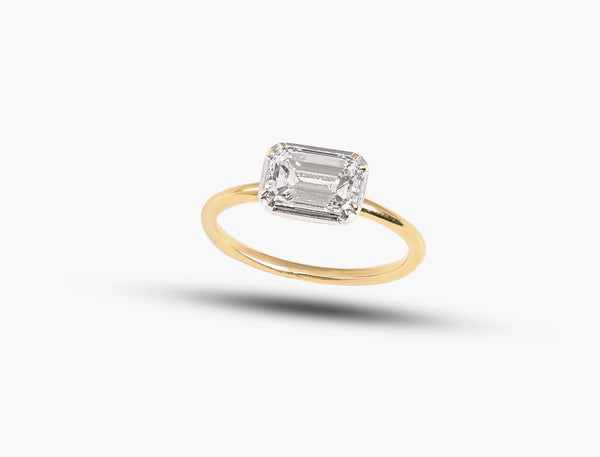
Different diamond cuts influence how the colour of a stone is perceived. A round brilliant cut is associated with concealing colour, its facets maximising the light that passes through the stone and making slight hues less noticeable. In contrast, cuts such as the emerald cut have long, open facets that can make any traces of colour more apparent.
How carat size impacts diamond colour
The size of a diamond can also affect the perception of colour. Diamonds of a higher carat weight have a greater surface area, making colour imperfections more visible. As the carat size increases, you may consider a higher colour grade to maintain a colourless or near-colourless appearance.
When selecting a diamond, it is important to consider the interplay between shape, setting and carat weight in relation to colour, as each factor influences how colour is perceived. Our diamond experts can guide you to understand the nuances of a diamond's colour, and every Ralph Karouni diamond is meticulously evaluated against the 4Cs as prescribed by the GIA.
Frequently Asked Questions
What colour is an F or G-graded diamond?
Diamonds graded F or G fall within the near-colourless range on the GIA scale. An F-graded diamond is near-colourless, any hint of colour incredibly subtle and difficult to see with the naked eye. A G-graded diamond is also near-colourless, but may show the slightest hint of warmth under controlled lighting conditions.
Why is the colour of a white diamond important?
The colour of a white diamond directly affects its overall appearance. A colourless or near-colourless grade is highly sought after, as it allows the diamond to reflect light in a way that maximises its brilliance.
How does the GIA grade diamond colour?
The GIA grades white diamonds on a scale from D, colourless, to Z, light yellow or brown, based on the absence or presence of colour. The grading is carried out under controlled lighting conditions.
The House of Ralph Karouni
Featured


